Telescope status unknownlast heard from it at 6:39 PM
A backyard telescope that runs itself
Every picture here comes from one small smart telescope on a roof in Sunnyvale. On clear nights an AI runs it on its own. It picks what to shoot, waits for the right moment, aims, keeps an eye on the weather, turns the raw shots into a finished picture and posts it here. Nobody sits at an eyepiece.
Anyone can ask for something to be photographed. The software behind it all is open source on GitHub.
50 mm
lens, about the size of a coffee mug
3 × 5 Moons
each picture covers a rectangle of sky 3 full Moons wide and 5 tall
10 seconds
per shot
Dozens to hundreds
shots stacked into each picture
From request to picture
Two parts work together: the AI, on a computer in the house, and the telescope's own built-in software. This is the Dumbbell Nebula from 19 September, start to finish.
AI decides, watches, finishesTelescope aims, shoots, stacksThis site shows the result
The AI (a computer in the house)
The telescope
1 · Choose
1Pick what to photographAI
Either a person visiting this site asked for it, or the AI chose it from a list of objects not yet in the gallery. Visitors' requests go first. Both are on the Queue page.
↓
2Wait for the right momentAI
The sky has to be fully dark and the nearest weather station has to report clear. The object has to be above the roof and trees, but not straight overhead where the mount can't follow. And the telescope never points low toward the neighbours' houses.
2 · Aim
3Look up where it isAI
"M27" becomes a position in the sky from an astronomy catalogue. The AI sends it to the telescope with a filter choice: light-pollution filter for nebulae. →
4Swing overTelescope
Uses its compass, tilt sensor and clock to point roughly the right way. Close, rarely exact.
↓
5Check against the starsTelescope
Takes a picture and matches its star pattern against a star map, so it knows exactly where it is pointing. It corrects until the object is centred. If clouds hide the stars it can't match them, and the AI parks and tries again later.
3 · Shoot and stack
Every minute
7Keep watchAI
Counts shots kept and thrown out. No new shot for six minutes means cloud: it parks the telescope and retries in half an hour. It also watches the battery and runs a small heater to keep dew off the lens.
8Call it doneAI
Stops after the planned time. That's anywhere from ten minutes to over an hour, depending on how faint the object is and how long it stays up.
Over and over, back to back
6aFollow the skyTelescope
Motors keep turning so the object stays in view as the Earth rotates.
6bTake a 10-second shotTelescope
Each one on its own is dim and grainy.
6cLine it up and add itTelescope
Matches the new shot's stars to the pile so far, shifts and turns it to fit, and adds it in. A shot spoiled by a plane, a gust or a cloud gets thrown out.
↻ about four shots a minute. The Dumbbell kept 67.
4 · Finish and post
9Hand over the stackTelescope
One file with all 67 shots combined: 11 minutes of light, kept at full detail.
↓
10Turn it into a pictureAI
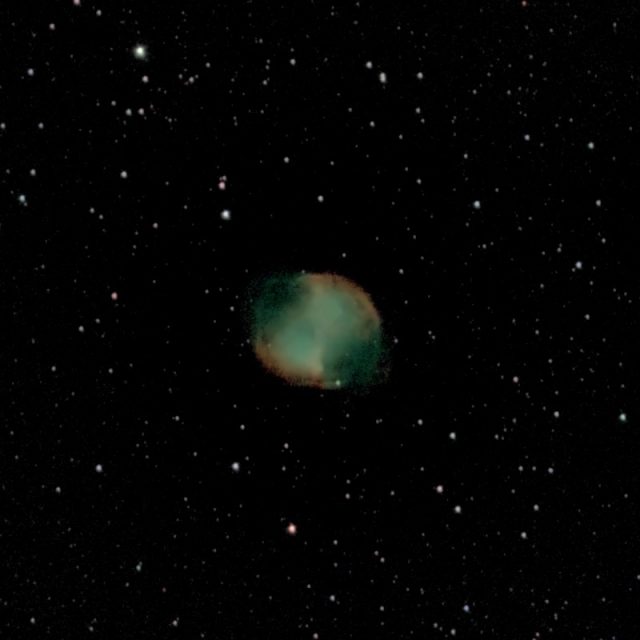
Removes the glow from city lights, brings up the faint gas so the eye can see it, cleans out colour speckle, and crops a close-up. The whole-field version is kept too.
↓
11Post it hereThis site
With how many shots, how long each, the filter used, and who asked for it. If it was your request, it says "Requested by" you.
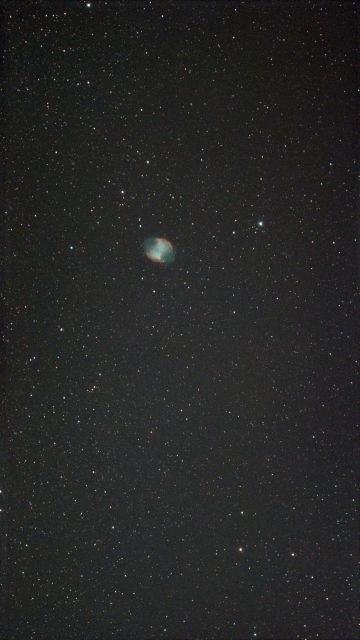
What the telescope makesIts own quick version of the stack, whole field.
→
After the AI finishes itSame 67 shots, glow removed, faint gas brought up, cropped.
Why lots of short shots instead of a few long ones?
The telescope never holds perfectly still on the sky, so short shots come out sharper.
The view slowly turns. This telescope swivels and tilts like a camera on an ordinary tripod. Big observatory telescopes are tipped to line up with the Earth's axis. It can keep an object centred, but over time the picture rotates around it. In 10 seconds that doesn't show. Over 30 seconds, stars near the edges start to smear.
Small wobbles add up. Wind and tiny motor errors blur a long shot more than a short one.
Bad luck costs less. A plane crossing the view spoils 10 seconds, not a whole minute.
Stacking makes up the difference. Because every shot gets lined up again before it's added, the drift between shots doesn't matter. Sixty-seven 10-second shots come out almost as clean as twenty-two 30-second ones.
What makes a picture better is more total time. The Great Pegasus Cluster used 471 shots, 78 minutes of light, and it's the best picture here so far.
Want something photographed? Ask for any galaxy, nebula, star cluster, planet or the Moon that's visible from California.
How it sits on the roof. The telescope rides on a homemade wooden platform bolted to the eave, with a quick release so it can come indoors without losing its alignment to the sky. Parts list, measurements, diagrams and photos for anyone who wants to copy it.